Think back to your own school days for a second. Remember sitting in a crowded classroom, staring at a blackboard covered in complex algebraic equations or chemical formulas and wondering, ‘When am I ever going to use this in real life?’ It is a question that has rung through school corridors for generations. Today, walking into a modern classroom at a forward-thinking School in Nagpur you will see a completely different scene. Students are not just copying notes from a board but are huddled around a low-cost robotic arm they built themselves, calculating angles to make it pick up a block and writing a basic script to automate the process. This shift is not a random experiment. It is part of a big movement across the country. The rising focus on STEM education in India shows a major turn away from old-style, textbook-heavy teaching toward methods that actually connect with the modern world. Central boards are redesigning classroom environments, ensuring that learning feels alive, interactive and directly tied to the challenges of the twenty-first century.
What Does STEM Education Mean?
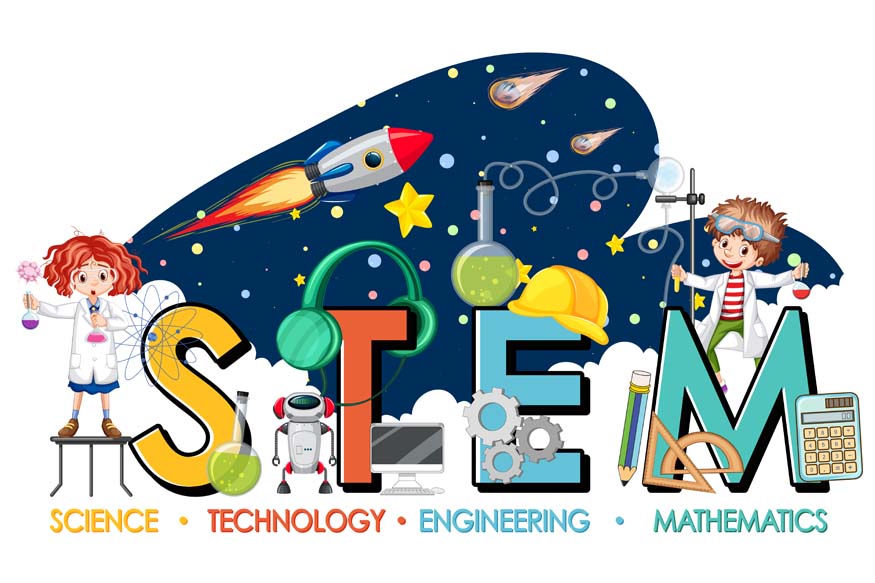
STEM stands for Science, Technology, Engineering and Mathematics. In traditional school systems these subjects existed in their own isolated bubbles. You would study biology at nine in the morning, open a math textbook at eleven and head to a computer lab once a week to type basic commands. The connections between them were rarely discussed. Integrated learning approaches tear down those artificial walls. It treats these four subjects not as separate disciplines, but as an interconnected network.
When a student designs a small water filtration system, they are practicing science by understanding filtration materials, engineering by planning the physical structure, math by measuring flow rates and technology if they use digital sensors to track water clarity. This approach makes a big difference in how the human brain processes data. Instead of forcing children to memorize abstract rules for a test it anchors every concept to a real physical reality. This model is becoming a key part of the modern CBSE School Curriculum, changing how teachers plan their daily lessons and how students demonstrate a deep understanding of their coursework.
How CBSE Encourages Integrated STEM Learning
The Central Board of Secondary Education has moved toward experiential learning models. This is where CBSE integrated STEM methods become incredibly important. Instead of expecting children to absorb heavy theory chapters through pure lecture delivery the board pushes for project-based learning. Schools are transforming standard classrooms into active labs equipped with coding kits, basic robotics components and interactive tools.
Here is something interesting about how this works out in a real classroom. Take a standard topic like wind energy. In a traditional lesson a student might draw a windmill in their notebook and label its parts to pass an exam. In an integrated setup, that same student works within a group to build a small, working wind turbine using cardboard, small motors and wires. They calculate voltage results using a multimeter, see how blade length changes energy production and write a simple data sheet tracking their findings.
This process naturally builds deep analytical thinking. Students learn that failure is just an extra step in design, if the turbine does not spin, they fix the physical setup or recalculate their mathematical ratios. This experiential approach fits directly into the new CBSE School Curriculum which intentionally replaces rote memorization with continuous practical evaluations.
STEM Benefits for Students
When schools adopt this mixed approach, the long-term effect on a child’s development becomes obvious. Let’s break down the main benefits that go far beyond standard report cards.
- First, it builds advanced problem-solving skills. Real-world challenges do not arrive neatly labelled as chemistry questions or geometry problems. They are messy and complex. By learning through integrated projects, students discover how to look at an issue from multiple angles, break it down into manageable parts and apply different tools to solve it.
- Second, the connection to real-world uses keeps interest levels incredibly high. Students stay deeply interested when they see immediate practical proof of what they are learning. Math is no longer just random letters and numbers on a page when it is used to program a drone’s flight path.
- Third, these projects naturally build teamwork and communication. Since modern interactive tasks are rarely solo assignments, students must work together, assign specific roles, debate ideas and present their group results clearly. These interactions look like modern workplaces, teaching kids how to handle differing opinions and pool their individual strengths.
- Finally, it ensures long-term future career readiness. The global job market is shifting rapidly, with emerging fields like artificial intelligence, data analytics, renewable energy engineering and biotechnology taking centre stage. A science, technology, engineering and maths school provides students with the flexibility needed to handle these technical fields with confidence.
Why Parents Are Paying Attention to STEM-Based Schools
You might notice that the factors parents used to choose schools have changed completely over the last decade. It is no longer just about which school has the highest board exam scores or the most traditional building. Parents realize that the global economy values what you can do with your knowledge far more than how many facts you can memorize. This shift has sparked a major demand for forward-thinking schools that integrate practical innovation into daily learning.
When families look for a Top school in Nagpur, they actively seek out environments that offer great innovation labs, hands-on science programs and interactive mathematics classes. The location of educational areas in the region has adapted to this demand. For instance, finding an advanced School in Amravati Road has become a priority for suburban families who want top-tier facilities without forcing their children into long daily drives.
Choosing a modern school means ensuring a child has access to tools and teaching methods that build true curiosity. Educational schools located across the expanding School in Amravati Road area have responded by investing heavily in specialized teacher training, updated laboratory equipment and collaborative project spaces. This ensures that students living in these developing residential sectors receive an education that matches international standards. For parents, this is a long-term investment in building a child’s confidence, adaptability and intellectual independence. This is exactly why a Top school in Nagpur must continuously evolve its teaching style to stay relevant.
Nurturing Future Leaders: Centre Point School
As education shifts toward this integrated future, Centre Point School stands at the very forefront of this transformation in the region. Known for its forward-thinking vision and deep commitment to well-rounded student development the school combines tough academic systems with practical hands-on learning. By designing specialized learning labs and encouraging students to explore the connections of science, technology and design, Centre Point School ensures that every child develops an analytical way of thinking. The school’s unique approach moves entirely away from traditional textbook limits turning everyday lessons into exciting, collaborative journeys. This focus on critical thinking and real-world application creates an environment where students do not just learn information they learn to innovate, experiment and lead with absolute confidence.
Frequently Asked Questions
What makes integrated approaches different from regular science and math classes?
Traditional classes teach science and math as isolated subjects with separate textbooks and exams. Integrated approaches combine these subjects into single, project-based activities, showing students how math and technology are used to solve real scientific and engineering problems.
Does a technical focus mean arts and languages are ignored in the classroom?
Not at all. A balanced curriculum ensures that languages, social studies and creative arts remain highly valued. Technical activities actually require strong communication, writing and presentation skills which helps students appreciate how technical and creative fields rely on each other.
Are these programs suitable for students who do not want to become engineers?
Yes, absolutely. The core focus of this method is teaching critical thinking, logical reasoning and collaborative problem-solving. These thinking skills are incredibly valuable in every career path, including law, business management, creative design and public administration.
How do teachers evaluate student progress in an integrated learning environment?
Evaluation moves away from purely written memory tests. Teachers assess students based on project models, research presentations, problem-solving approaches and their ability to work effectively within a team structure alongside regular academic tests.
Is specialized infrastructure required for a school to offer effective learning?
While advanced innovation labs and robotics kits add great value, effective learning depends more on teaching methods than expensive equipment. Simple, low-cost materials can be used to teach deep principles of physics, environmental science and mathematical modelling.