Do you remember ever sitting in a classroom, staring at a complex diagram of a plant cell or a historical map, wishing there was a way to remember information without just memorizing a textbook? Most students have been there. For a long time, the school system felt like a race to see who could memorize the most facts. But things are shifting in a big way. With the recent CBSE curriculum changes, arts programs are finally being treated with the importance they deserve, it is acknowledging something that artists and psychologists have known for decades: creativity isn’t a distraction; it’s a superpower for learning. This transition has been successfully implemented, if you are looking for a best school in Nagpur.
By making art education in CBSE a compulsory part of the journey, the board isn’t just trying to find the next Picasso. They are trying to build better thinkers. This isn’t just about an extra hour of drawing or music in the week; it’s a fundamental change in how education is delivered to students across the country.
Let’s look at it this way: Why the sudden change?
For years, art was tucked away in a corner of the timetable, usually reserved for a Friday afternoon when everyone was already thinking about the weekend. It was seen as extra or co-curricular. However, the importance of art in education has become impossible to ignore. Modern research shows that when you engage with a subject through a creative lens, whether that’s drawing a scientific process or acting out a historical event you aren’t just learning; you’re experiencing.
The board realized that to prepare students for a world that’s constantly changing, they need more than just high marks. They need the ability to solve problems, think critically, and communicate ideas. This is where the CBSE School Curriculum is evolving. It’s moving away from the industrial model of education and moving toward a model that celebrates individual expression.
The Secret Sauce: Art Integration and the NEP
You might notice parents and teachers talking a lot about “Art Integration” lately. This isn’t just a buzzword. It’s a core pillar of the art integration NEP (National Education Policy) guidelines. The idea is simple: instead of teaching art as a standalone subject, you weave it into everything else.
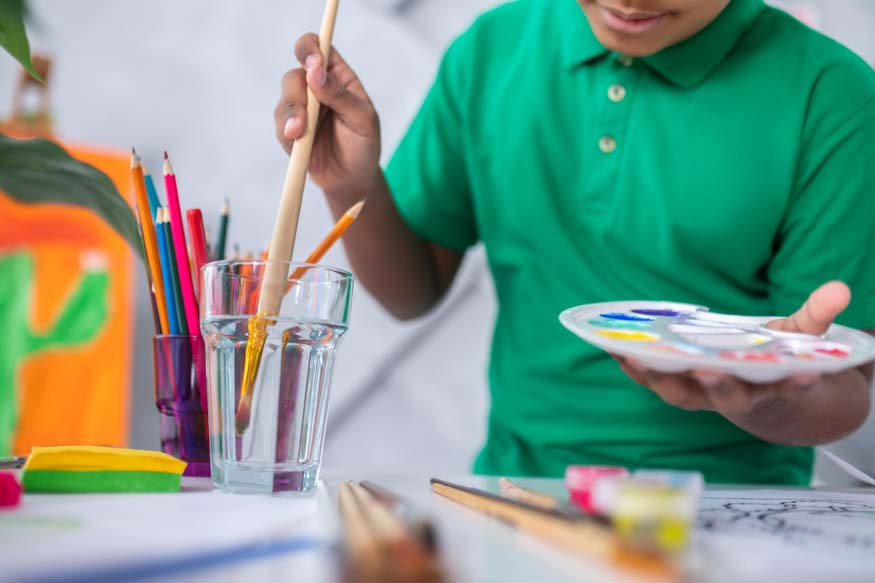
Imagine a math class where you learn geometry by studying old cultural tile patterns or a geography class where you understand terrain by sculpting clay maps. This approach provides massive creative learning benefits. It takes the “scary” out of difficult subjects. When a student uses their hands to create, the brain processes that information in a much deeper way. It moves from short-term memory to long-term understanding.
How this looks on the ground in Nagpur
If you’re looking for a School in Nagpur, you’ll see this transition happening right before your eyes. In the past, schools in our city might have focused heavily on science and Math. But today, even the Best School in Nagpur is finding ways to make space for the kiln, the stage, and the studio.
For families living near the city outskirts, finding a high-quality CBSE schools in Amravati road used to be about finding the building with the best labs. Now, it’s about finding the school that has the best creative philosophy. The hallways are becoming more colourful, and the projects are becoming more imaginative.
Breaking the “Rote Learning” Habit
We all know the drill: read the chapter, answer the questions at the back, take the test, and then forget everything two weeks later. Rote learning is a hard habit to break, but the importance of art in education is the best tool we have to fight it.
When a student has to represent a concept through a medium which can be a song, a painting or a short play they have to understand it first. You can’t paint a picture of a chemical reaction if you don’t understand how the molecules interact. This forced understanding is one of the primary reasons why art education in CBSE is now a mandatory requirement. It ensures that “A” grades actually reflect real knowledge, not just a good memory.
Here’s something interesting: Art as a Stress-Buster
It’s no secret that school can be stressful. Between the competitive exams and the heavy bags, students are under more pressure than ever. Integrating art into the daily routine acts as a natural pressure valve.
When students engage in creative work, their brains enter a flow state. It’s a meditative process that reduces cortisol (the stress hormone) and boosts dopamine. This means that by spending time on art students actually return to their core subjects like Math or Physics with more focus and a clearer mind. In the recent CBSE curriculum changes, arts updates demonstrate that the value of creative study extends far beyond traditional learning metrics it isn’t just about academics; it is about mental well-being.
The Practical Side: Skills for the Future
Let’s be real—how many of us use advanced trigonometry in our daily adult lives? Some do, but everyone needs to know how to present an idea, how to collaborate with a team, and how to look at a problem from a different angle. These are the “soft skills” that are actually quite hard to teach.
The art integration NEP framework builds these skills naturally.
- Collaboration: Working on a school mural or a theatre production requires teamwork.
- Problem Solving: What do you do when the paint runs or the prop breaks? You innovate.
- Communication: Art teaches you how to convey a message without saying a word.
FAQs
Why is art education now required by CBSE?
In order to promote general growth and make learning more imaginative and useful, CBSE has incorporated art. The goal is to move away from memorization and toward genuine understanding.
What does CBSE’s art education cover?
Drawing, painting, music, dancing, drama, crafts, and creative undertakings related to other subjects are all included. It’s a broad umbrella that allows every student to find something they enjoy.
How does art integration NEP help students?
It helps students understand concepts better by connecting subjects with creative activities and real-life examples. This makes the learning process more relatable and less abstract.
Will grades for art education be the same as those for other subjects?
Instead of using traditional written exams, it is typically evaluated through activities, participation, and projects. This reduces exam stress while still ensuring students stay engaged.
What advantages do students receive from art education?
The creative learning benefits include increased self-assurance, enhanced creativity, decreased stress, and improved learning. These skills are essential for both higher education and future careers.
Challenges and the Path Forward
Of course, making art compulsory isn’t a magic wand. It takes resources. It takes trained teachers who know how to facilitate a creative classroom without it turning into chaos. Some schools might struggle with the transition, especially those that have been “strictly academic” for decades.
However, the shift is inevitable. The world doesn’t just need more employees; it needs more creators. The CBSE School Curriculum is finally catching up to the reality of the global job market. By starting this journey in the early years of schooling, we are giving the next generation a massive head start.
Wrapping It Up
The decision to weave art into the very fabric of our schools is a bold but a necessary move. Through art education in CBSE, we are acknowledging that every child learns differently. The CBSE curriculum changes arts represent a future where a student’s imagination is just as important as their ability to solve an equation.
Whether you are a parent looking at a School in Nagpur or a student curious about these new classes, embrace the change. The importance of art in education isn’t just a theory anymore it is the new reality. With the art integration NEP guidelines paving the way, the classrooms of tomorrow are going to be a lot more interesting than the ones we grew up in.
The Centre Point School Approach
At Centre Point School, we don’t view art as an extra activity to be checked off a list. Considered among the Best School in Nagpur, we have spent years refining our approach to ensure that creativity is the heartbeat of our campus. We understand that every child has a unique voice, and our role is to provide the megaphone. From our state-of-the-art facilities to our faculty who are trained in the latest art integration NEP techniques, we make sure that our students are prepared for the 21st century.
We have seen firsthand how a child who struggles with traditional reading can blossom when given a chance to explain their thoughts through a storyboard or a sculpture. This holistic growth is what sets a truly great school apart.
Finding the Right CBSE schools in Amravati Road in Nagpur
Choosing a school is one of the biggest decisions a parent can make. If you are looking at CBSE schools in Amravati Road, the questions you ask during the tour should be different now.
Don’t just ask about the topper list. Ask how they are implementing the latest CBSE curriculum changes, arts directives. Ask to see the art studio. Ask how they integrate music into their history lessons. A school that embraces these changes is a school that is looking toward the future.
If you’re ready to see how a modern, creative-focused education can transform your child’s future, don’t wait. Secure your child’s spot today through the CBSE School Admission process and watch them colour their way to success! Enquire now!